
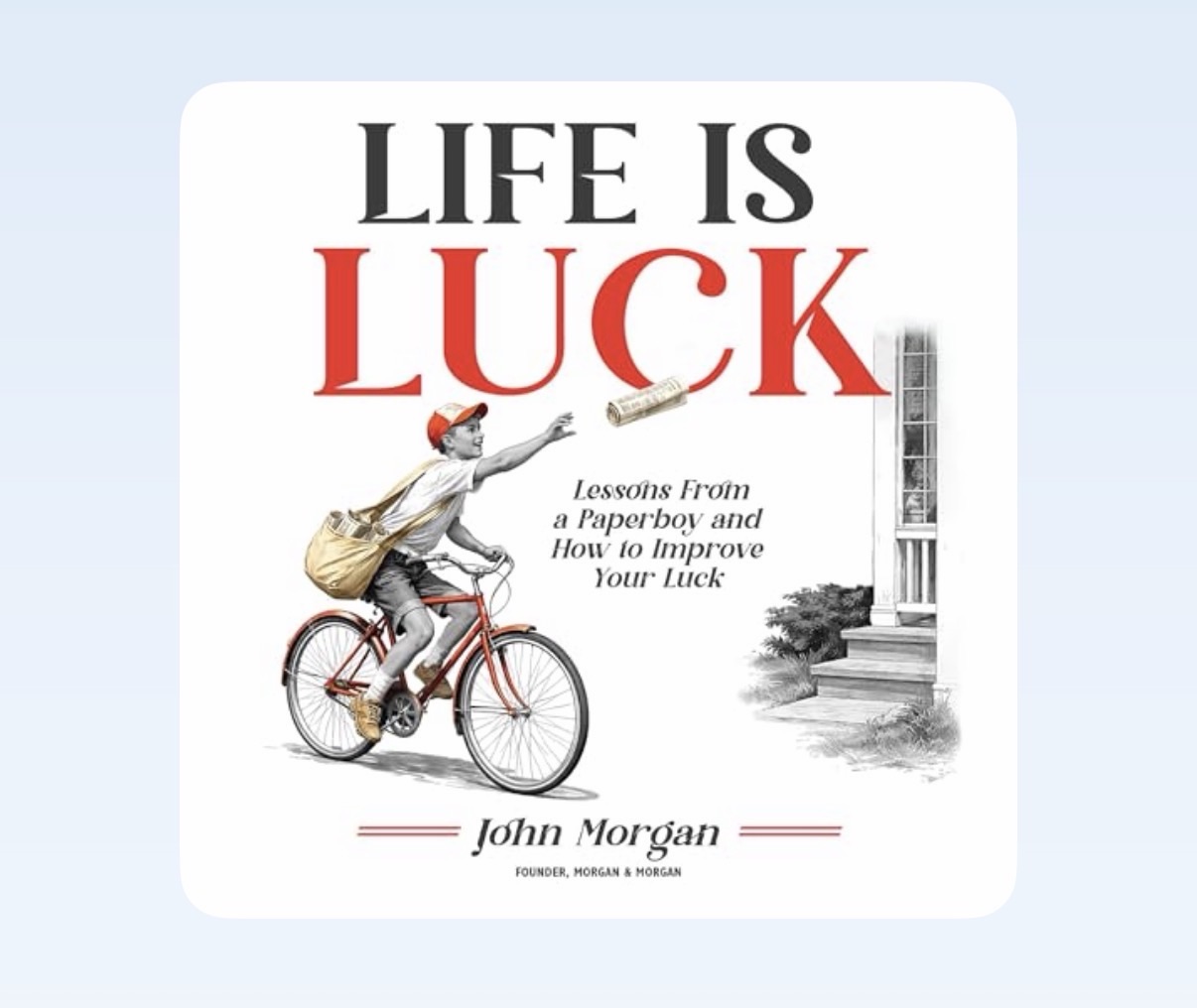
I just finished reading Life Is Luck by John Morgan, the founder of Morgan & Morgan, and I enjoyed it so much that I already plan to read it again.
Morgan is one of the most fascinating entrepreneurs in America. He happens to be a lawyer, but after reading his book, I’m convinced he’s really a businessman who built a law firm. And he’s built quite a few other businesses along the way.
What initially convinced me to read the book was watching Morgan being interviewed by Houston attorney Tony Buzbee on his podcast. I’d heard Morgan talk about his business philosophy before, including his strategy of expanding into new markets rather than concentrating everything in one city. He calls it his teacup strategy. Instead of continuing to pour into a cup that’s already full, he finds another cup.
That philosophy has helped him build Morgan & Morgan into one of the largest personal injury law firms in the country. And he’s not finished. His latest moonshot is transforming the firm into something resembling what Google might look like if Google were a law firm. He’s thinking about technology, scale, systems and expansion on an entirely different level.
But what makes Life Is Luck such an interesting book isn’t just the business advice. It’s Morgan’s understanding of how much of our lives is determined by circumstances we didn’t create.
He begins with a fascinating comparison between a lion and a sloth.
Every day, somewhere in the world, a lion is born and a sloth is born. The lion enters the world with tremendous natural advantages, while the sloth is an animal that spends much of its life sleeping and moving slowly. Neither animal chose what it would be.
Morgan uses that comparison to make a larger point about human beings.
Some people are born with extraordinary energy, ambition, intelligence or natural abilities. Others aren’t. Even our capacity to work hard, the very thing successful people often take the most pride in, is influenced by circumstances beyond our control.
That’s an incredibly important distinction.
Morgan isn’t arguing that success is simply a matter of luck or that hard work doesn’t matter. He’s spent his entire life working extraordinarily hard, taking risks and building businesses.
But he recognizes something that many successful people seem unwilling to acknowledge: Even having the opportunity and ability to work hard is partly a matter of luck.
Being born is luck. Being born in the United States is an extraordinary stroke of luck. The families we’re born into, the people we meet, our natural abilities, our health and the opportunities that come our way can change everything.
People who work incredibly hard often resist attributing any of their success to luck. After all, they put in the hours, took the risks and made the sacrifices.
But those accomplishments don’t eliminate the role of chance.
Morgan’s philosophy isn’t simply about making your own luck. It’s about recognizing the enormous role luck already plays in our lives, making the most of whatever opportunities we receive and understanding that even our greatest personal strengths may be gifts we didn’t earn.
That perspective runs throughout the book.
Morgan didn’t grow up wealthy. His childhood included significant adversity, including an alcoholic father and financial instability. He struggled in school and was even held back a grade.
But he has an extraordinary ability to take what initially looks like adversity and turn it into something valuable.
One of my favorite stories involves the teacher who helped him improve his reading after he was held back. She had never married, and one day he asked her why.
She explained that she had been so beautiful when she was younger that men might have assumed she was already involved with someone.
Years later, Morgan saw an extraordinarily beautiful woman at an evening Mass. Remembering his teacher’s story, he introduced himself.
That woman became his wife.
Think about that. An experience that might have seemed like a terrible setback for a young boy ultimately helped shape one of the most important relationships of his life.
And it happened because he remembered a conversation with someone whose path he might never have crossed had he not been held back in school.
That’s the kind of story Morgan tells throughout the book.
He also challenges the way people think about wealth.
One of his observations is that pretending to be rich can actually create bad luck. Spending money to impress people, maintaining an expensive lifestyle and trying to project an image of success can leave someone without the financial resources to pursue a genuine opportunity when it arrives.
There’s a difference between being wealthy and looking wealthy.
He discusses imposter syndrome, the importance of surrounding yourself with good people, and the difference between simply doing what everyone else does and thinking from first principles.
One of his examples contrasts a cook with a chef.
A cook follows a recipe. A chef understands the ingredients and principles well enough to create something new.
That distinction particularly resonated with me because I’ve spent much of my career trying to build systems rather than simply repeat conventional approaches to business.
Morgan is constantly thinking about how things work, why they work and whether there’s a better way to do them.
And his interests go far beyond practicing law.
At one point, Morgan explains that he doesn’t hunt animals. He hunts money.
Building businesses is his hobby. He genuinely enjoys figuring out what people want, how to provide it and how to make the economics work.
He talks about building attractions, hotels and restaurants. He explains the economics of the restaurant business, how he evaluates opportunities and how he approaches industries where he might initially have little experience.
One particularly interesting story involves his National Museum of Crime and Punishment in Washington, D.C.
The museum ultimately failed, but Morgan didn’t abandon the concept. He recognized that the idea itself wasn’t necessarily the problem. The location and economics were.
He took what he’d learned and developed Alcatraz East in Pigeon Forge, Tennessee, which became an enormously successful attraction and, according to Morgan, his most profitable.
That’s another example of his philosophy about luck. Sometimes what looks like bad luck becomes an opportunity, but only if you recognize what happened, learn from it and are willing to try again.
He also discusses doing business with Jimmy Buffett, working with legendary attorney Johnnie Cochran and his friendships with some of the country’s most successful trial lawyers, including Brian Panish.
The stories alone make the book worth reading.
But what I found especially interesting is how Morgan approaches the relationship between business and family.
He discusses the difficulties of multigenerational family businesses, which frequently struggle as ownership and leadership pass from one generation to the next.
His own situation is unusual because all four of his children are involved in the family business, including three who became lawyers and another who works on the financial side.
That’s remarkable because children don’t necessarily inherit their parents’ ambitions simply because they inherit their opportunities.
A parent may build a business from nothing, driven by necessity, ambition and a dream. Their children grow up in entirely different circumstances. They may love their parents and want to make them proud, but the business was never necessarily their dream.
Morgan seems to recognize how fortunate he is to have built something his children also want to be part of.
He also talks about the good fortune that can come from marriage and in-laws, and even references Robert Earl Keen’s hilarious Christmas song, “Merry Christmas From the Family.”
There are wonderful literary and cultural references throughout the book.
He mentions The Purpose Driven Life, which I’ve read, and recommends Richistan, which is now next on my reading list.
I also enjoyed his discussion of Muhammad Ali and Joe Frazier’s legendary 1975 fight in Manila.
Both fighters were absolutely exhausted. After 14 brutal rounds, Ali was nearly finished himself, but he was prepared to continue. Frazier’s trainer stopped the fight before the final round.
The remarkable thing is that Ali was barely capable of continuing either.
Had Frazier been allowed to fight another round, who knows what might have happened?
It’s a fascinating illustration of how thin the margin between winning and losing can be.
Sometimes the difference is simply getting up one more time. Sometimes it’s the decision someone else makes. Sometimes it’s an opportunity that arrives at precisely the right moment.
And sometimes it’s luck.
Morgan also talks about gratitude, generosity and the importance of living a good life.
He closes the book with a reflection associated with Mother Teresa about choosing kindness, forgiveness and love even when those things aren’t returned.
That seems particularly fitting because, for all his extraordinary financial success, the book ultimately isn’t just about making money.
It’s about understanding the circumstances that make our lives possible.
Morgan doesn’t suggest that we should stop striving because luck plays such a large role in our success. Quite the opposite.
We should work hard, take risks, keep learning, recognize opportunities and make the most of whatever advantages we’ve been given.
But we should also have the humility to recognize that we didn’t create every advantage we possess.
And perhaps that recognition should make us a little more grateful for our own circumstances and a little more generous toward people whose luck hasn’t been as good.
There’s something refreshing about hearing that perspective from a billionaire who could easily attribute everything he’s accomplished to his own brilliance, discipline and determination.
Morgan doesn’t diminish his accomplishments by acknowledging luck. If anything, his willingness to recognize it makes his perspective more compelling.
Life Is Luck is part autobiography, part business book and part philosophy of life. It’s filled with memorable stories, practical insights and the perspective of someone who has spent decades building things, sometimes succeeding spectacularly and sometimes failing.
What I appreciate most is that Morgan doesn’t present success as a simple formula that anyone can follow and expect the same results.
He recognizes that life is much more complicated than that.
Hard work matters. Intelligence matters. Ambition matters. Preparation matters. Relationships matter.
But so does chance.
And even the qualities that allow us to take advantage of chance are, to some extent, the result of luck.
I highly recommend Life Is Luck, particularly to entrepreneurs, business leaders and anyone interested in how success actually happens.
I’m going to read it again. And I suspect I’ll get even more out of it the second time.
It’s one of the most interesting books I’ve read in a long time.


